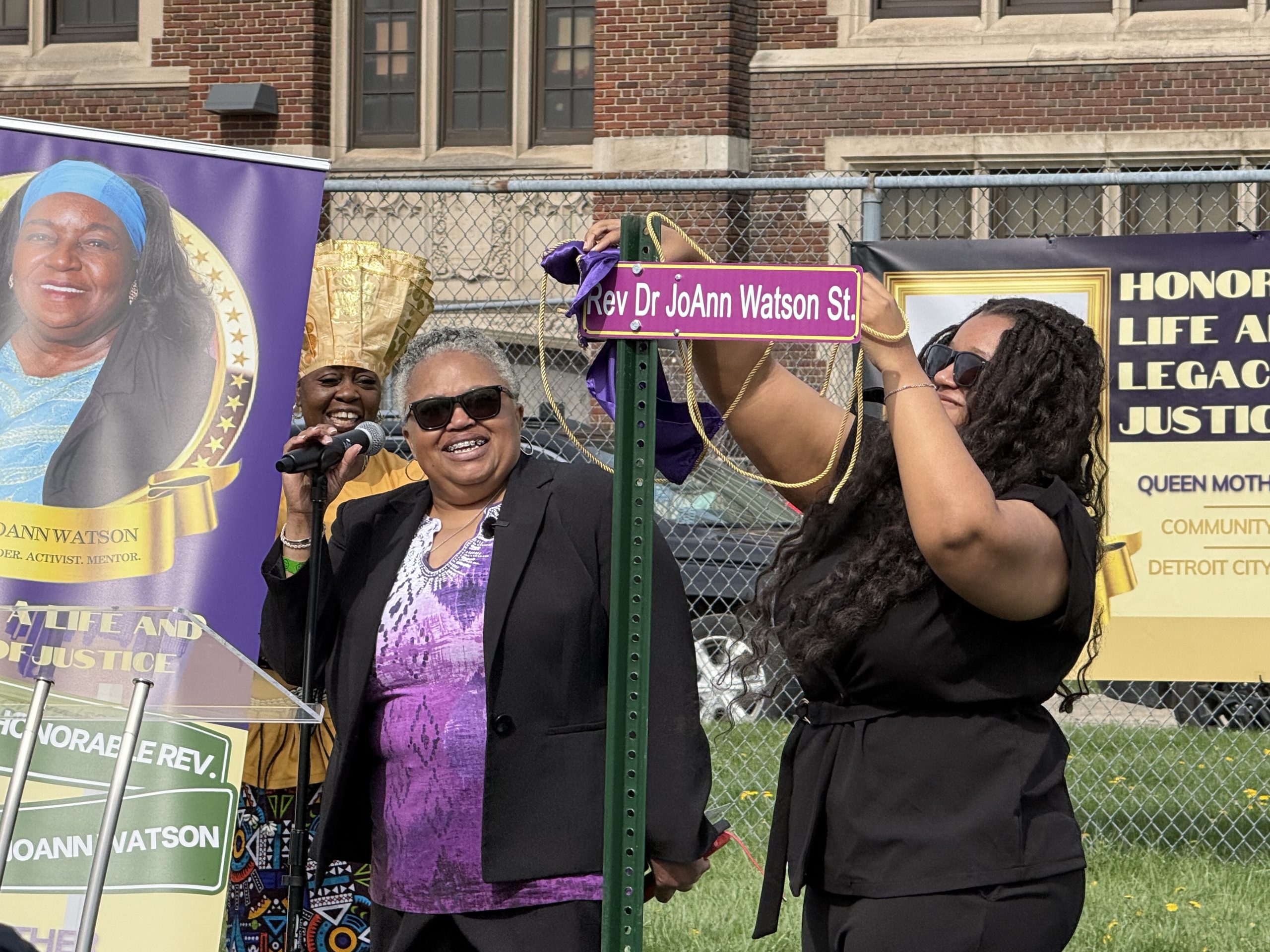
JoAnn Watson got her street sign on April 17, 2026. The ceremony happened at Central High School, tucked near the corner of Tuxedo and Linwood, and it drew a crowd that had known Watson across different decades and different versions of Detroit.
Watson died in July 2023 at 72. The sign went up a couple of days before what would have been her 75th birthday.
Mayor Mary Sheffield was there Friday, and she didn’t keep things abstract. She talked about 2013, the year she ran for Detroit City Council and won, becoming the youngest council member in the city’s history at 26. That race happened because Watson stepped aside. Watson chose not to run in the same district. Sheffield has said it plainly before, and she said it again in front of the crowd at Central High School.
“The entire trajectory of my life has changed because of that one run in 2013,” Sheffield said. “I know that I wouldn’t be here if it had not been her sacrificing her service.”
Sheffield co-sponsored the secondary street sign while she was president of the Detroit City Council, before she became Detroit’s first woman mayor. That’s not a small chain of events. One person steps back in one local race, and more than a decade later the city has its first female mayor standing at a school on the west side, talking about what that step back meant. Sheffield called Watson “bold and unapologetic,” which felt less like a eulogy phrase and more like a precise description.
“No matter how you came to know Rev. Watson, one thing was very clear: She was a fighter for our people,” Sheffield said.
A Career That Crossed Decades and Continents
Watson’s public record runs long. She served on the Detroit City Council from 2003 to 2013, a full decade spent pushing hard on water rights and human rights. Before the council, she became the first woman director of the Detroit NAACP. She worked as a public liaison for the late Congressman John Conyers Jr. She pastored at West Side Community Church.
She also hosted “Wake Up Detroit!,” a radio and television program that speakers on Friday described over and over as something that actually moved people. That’s not nothing in a city where plenty of civic media comes and goes without leaving much behind. Watson’s show left something behind.
Maxine Willis worked alongside Watson at WHPR FM, the city’s Black-owned and operated radio and television network. Willis didn’t try to dress it up.
“Her voice may be silent but her impact will continue to echo,” Willis said.
Watson’s organizational footprint stretched further still. She held positions with the Black Legacy Coalition, the Detroit Council of Elders, and the Unity Urban Ministerial School. Her reach went past Detroit’s city limits too, and her advocacy connected to conversations at the United Nations level. Sheffield appointed her to lead the voter-approved Detroit Reparations Task Force, which fit. Watson had carried the cause of reparations for descendants of enslaved people through her entire public life, and she was still carrying it when she died.
The ceremony ran about two hours. People who knew Watson from the council years sat in the same room as people who knew her from the radio, from the church, from the reparations work. That kind of range doesn’t happen by accident. It builds over years, across institutions, through the kind of consistent presence Watson maintained from 2003 forward and well before that.
The City Council’s honorary naming process brought the sign into existence through formal channels, but the weight behind it came from the community that showed up Friday. Bridge Detroit covered the ceremony and the life it honored.
The sign now sits on the grounds of Central High School, near Tuxedo and Linwood, a few blocks deep into the kind of west side Detroit that Watson spent her career fighting for. It won’t tell passersby everything. It won’t explain the council votes, the radio hours, the reparations hearings, or the moment in 2013 when Watson chose to step aside and changed the course of someone else’s life. But the name is there, and the neighborhood knows what it means.
“Her voice may be silent but her impact will continue to echo,” Willis said.