Michigan’s wildfire smoke alert system is getting an earlier trigger this spring, and if you lived through the summers of 2023 and 2025, you understand why that matters.
The Michigan Department of Environment, Great Lakes, and Energy announced it’s dropping the threshold at which it sends air quality alerts to residents. The new standard: anytime fine particulate matter or ozone climbs into the orange band on the federal Air Quality Index, which officials classify as “unhealthy for sensitive groups,” the state sends a warning. That’s a meaningful shift from how the system worked before. Previously, the state waited until conditions hit the red, or “unhealthy,” range to issue alerts, and only sent advisories for the orange tier. Now the two-tier structure is gone. Orange is enough.
For Detroiters, especially folks in the 48217 zip code, which recorded some of the worst readings during the 2023 Canadian wildfire smoke events, this isn’t an abstract policy change. It’s the difference between getting a heads-up Tuesday morning or learning Wednesday afternoon that the air was bad while you were outside.
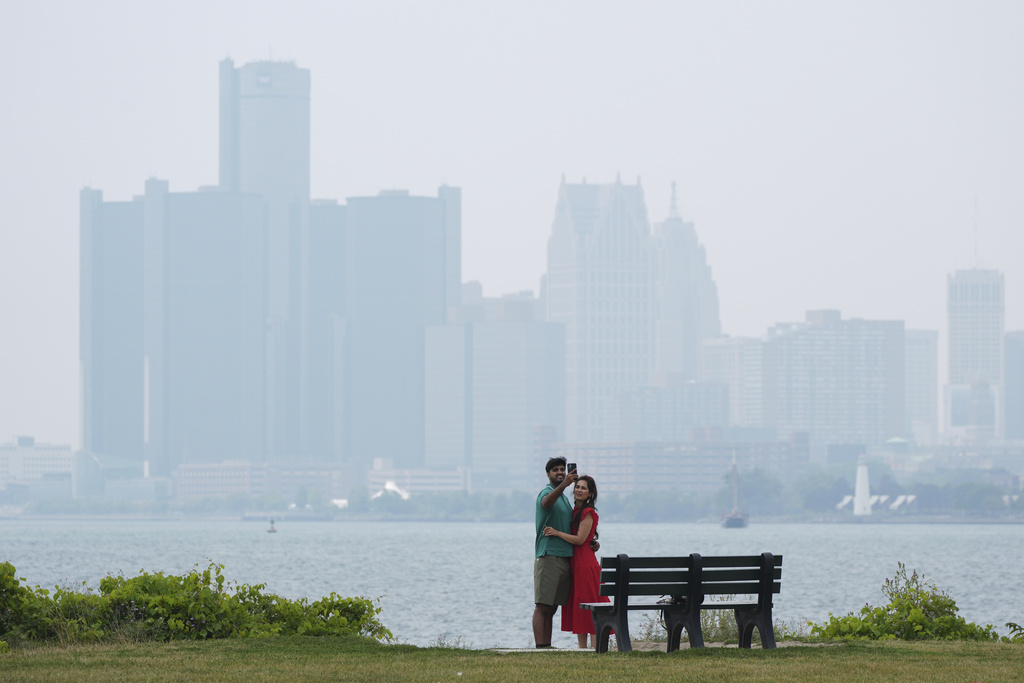
The 2023 and 2025 wildfire seasons showed how quickly things can turn. Smoke from fires burning hundreds of miles away in Canada blew southeast and pushed air quality readings into ranges that health officials said were genuinely dangerous for children, elderly residents, and anyone managing asthma or heart conditions. The state isn’t pretending that won’t happen again.
Jim Haywood, senior meteorologist with EGLE, is candid about what the forecasting can and can’t do. He doesn’t put much faith in smoke predictions beyond a 24-to-48-hour window, and he’s got reasons for that skepticism.
“It can be difficult to predict where smoke traveling over long distances will go, and if it will affect air quality or remain well above ground-level,” Haywood said.
That’s the core problem. Whether smoke from a fire in northern Ontario hugs the ground when it crosses into Michigan or stays 10,000 feet up depends on atmospheric conditions that shift faster than models can track. Haywood’s uncertainty is actually the argument for the earlier alert threshold: if you can’t reliably see what’s coming past 48 hours, you need the system catching problems at orange, not sitting on its hands until things turn red.
Haywood points residents toward the EPA’s AirNow webpage for a 48-hour air quality forecast. The EPA’s EnviroFlash program can push alerts directly to your inbox. If you want something more granular, JustAir and PurpleAir run private sensor networks that can show you block-by-block readings. FireSmoke Canada posts a multiday ground-level smoke forecast map covering most of Canada and the U.S.
The state isn’t making this change during a sleepy year. Forecasters are tracking conditions on multiple fronts.
In Canada, wildfire researchers are watching a complicated picture. Brian Wiens, managing director of the research partnership Canada Wildfire, told Bridge Detroit that he expects fewer fires north of the border than last year. Some areas have gotten help from recent storms. Drought and dry conditions still grip Saskatchewan, Manitoba, Ontario, and Quebec, though, so that relief is uneven.
The bigger unknown is a possible El Nino pattern. If it develops, it could drive heat into Alberta and British Columbia and push fire risk sharply higher in late summer. That’s the scenario Michigan officials are most focused on. The National Interagency Fire Center tracks U.S. fire conditions and can give you a read on what’s burning and where, which gives context to whatever smoke ends up drifting east.
Sixty-five air quality index. That’s the number to watch. Once readings clear that line, you’re in the orange range, and starting this spring, that’s when Michigan’s alert system fires. It won’t stop smoke from coming. What it does is give people time, even if that window is only 24 hours, to decide whether to keep their kids inside, reschedule outdoor plans, or get their inhaler somewhere they can reach it fast.