The Fisher Building’s 26th floor doesn’t show up on any public elevator panel. It never has.
Jacob Jones has spent more than a decade walking people through what most Detroiters walk past every day. He leads tours through the Fisher Building in partnership with Pure Detroit and the Albert Kahn Legacy Foundation, and he knows the building the way a building’s own bones know it. Every fresco. Every lunette. Every mechanical secret folded into ornament. On a private tour, he took a small group up to floor 26, which sits above the public elevator stops and one full floor below the old executive suites that occupied 27 and 28. Most people who pass through the Fisher Building’s arcade every single morning don’t know the floor is there.
“It’s rare today, I think, to have a building that combines beauty, combines engineering, and is also a place that is open and presented to the public on a daily basis,” Jones said.
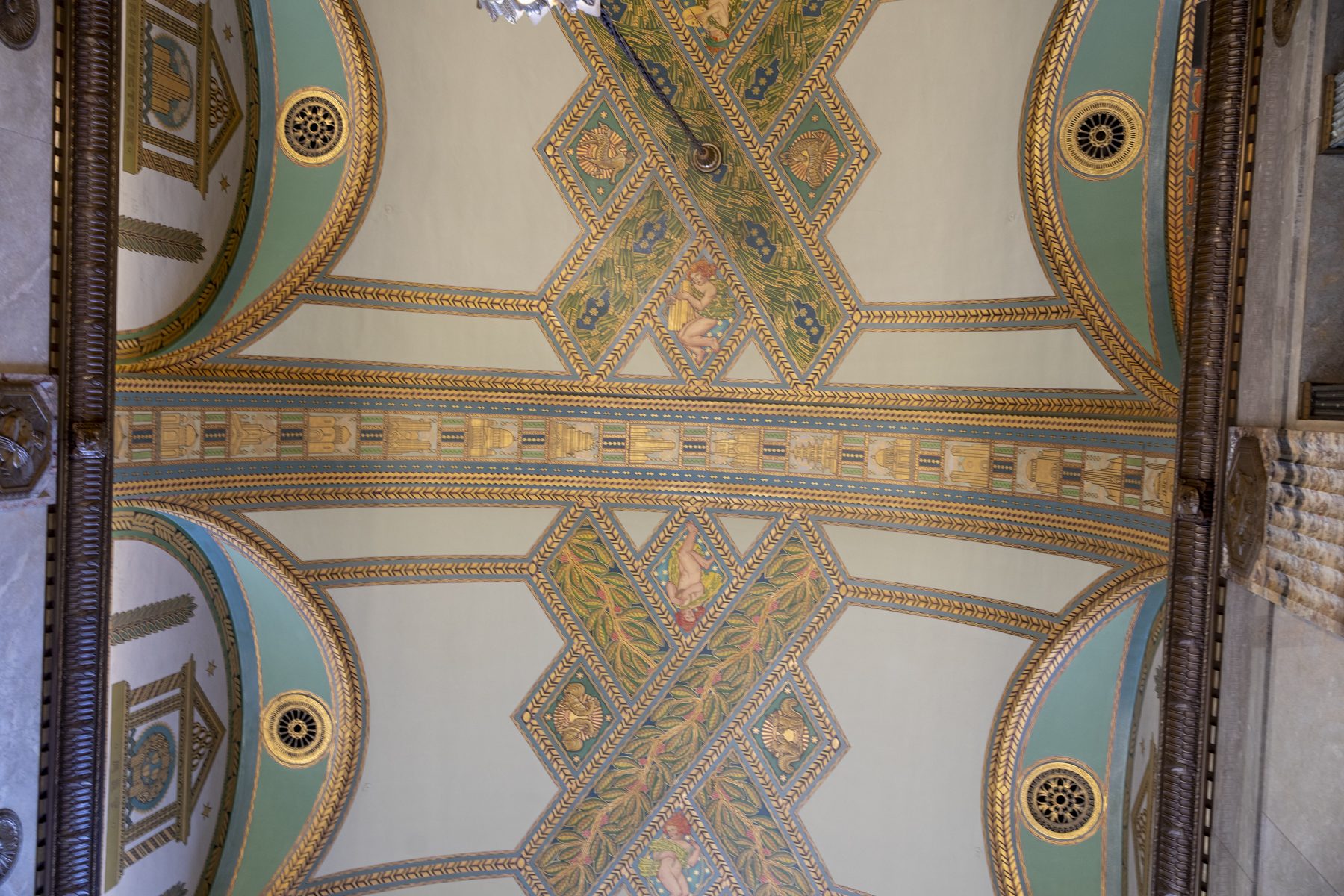
He’s not talking about it like a museum piece. The Fisher Building, opened in 1928 on West Grand Boulevard in the New Center neighborhood, isn’t behind velvet rope. It’s a working building on Second Avenue. Walk in on a Tuesday and the arcade is right there, no ticket, no reservation. Look up and you’re looking at frescoes executed by roughly 200 crew members working under Hungarian artist Géza Maróti. Count the bronze-colored medallions set into the lunettes along the arcade ceiling and you’ll get to 26 before you run out. Most people don’t count. Most people don’t look.
Those 26 medallions weren’t purely decorative. They were the building’s original ventilation system. The architects wrapped the air vents inside ornate bronze wheels so the mechanical infrastructure would dissolve into the visual program of the lobby. That’s the Fisher Building’s whole logic in one detail: function disguised so thoroughly it reads as art.
The frescoes near the West Grand Boulevard entrance carry their own coded message. Maróti worked images of Albert Kahn’s favorite structures into the ceiling, including the Pantheon and the Taj Mahal. He surrounded each lunette with words including “THRIFT,” “KNOWLEDGE,” “MUSIC,” “AGRICULTURE,” and “NAVIGATION.” None of those choices were random. They were chosen to reflect what the Fisher brothers wanted their company, and their city, to stand for.
Kahn’s reputation gets attached to the Fisher Building more than anywhere else, but that’s a selective version of his career. The man’s real output was industrial. His factory designs remade how American manufacturing physically worked. “He pioneered a version of steel-reinforced concrete that allowed for larger floor plans and for the massive windows that allowed natural light to pour into the factory,” Jones said. “Albert Kahn brought light to the working class.”
That’s not a metaphor. Kahn’s factory buildings, including the Packard Plant and Ford’s Highland Park facility, were built specifically to let daylight reach workers on the floor. The Fisher Building gets the cultural attention, and it deserves it, but it’s one building among hundreds Kahn designed across Detroit and beyond. Hour Detroit has covered some of what’s hidden throughout the structure, and the layers go deep.
Floor 26 was the first level of Fisher Body Company’s own offices. The brothers commissioned the building and then moved their auto-body firm into it. The reception space on that floor survived in a way that’s almost disorienting, details intact, mostly untouched. It doesn’t look like an abandoned floor. It looks like a floor that’s been waiting.
Jones keeps finding things that way. The building opened in 1928, which means it’s been standing on that corner of West Grand Boulevard for nearly a century, and it hasn’t finished revealing itself. The ventilation hides in the art. The art hides a world atlas of Kahn’s architectural obsessions. The 27th and 28th floors held the executives. The 26th held the front door to their world. And the arcade downstairs holds all of it, open every day, free to walk into, mostly ignored by the people rushing through it.
“It’s rare,” Jones said, and he means it precisely.